

Best Beds for Seniors with Mobility Issues in 2026
Getting in and out of a regular bed gets harder every year for a lot of seniors, and it's rarely just about comfort. Weak knees, balance problems, arthritis, or recovery from surgery can turn a simple task like standing up into a real safety risk. If you're searching for the best bed for seniors, you're probably trying to solve a specific problem: how to make transfers safer and mornings less painful, without turning a bedroom into a hospital ward.
The honest answer is that the right bed depends on the level of mobility loss you're dealing with. Someone who just needs extra back support sleeps fine in a Hi-Low adjustable bed, while someone who struggles to stand up on their own needs a rotating sit-to-stand hospital bed that does the heavy lifting for them. Both categories exist, and both can look like real furniture instead of medical equipment.
Below, we break down the best beds for seniors with mobility issues by need, covering rotating models, hi-low designs, and clinical-grade options built for home care, so you can match features to the actual challenges your loved one faces day to day, alongside our expert picks for hospital beds for seniors and elderly adults at home.
1. Rotating sit-to-stand beds for safe transfers
Rotating sit-to-stand beds solve the single biggest safety problem in home care: getting from lying down to standing up without a fall. Instead of a caregiver hauling someone upright by the arms, or reaching for a Hoyer lift instead of a sit-to-stand bed, the mattress deck itself pivots to the side of the bed and raises the person into a standing position at the push of a button. Transfer Master and Med-Mizer, two of the best home hospital bed brands, both build rotating platforms into their hospital bed lines, and they're the models most occupational therapists point to when a client can no longer manage a standard transfer safely. If you want to see how these work in practice, SlumberSource's collection of 90-degree rotating beds for home use shows the mechanism in action across several brands.
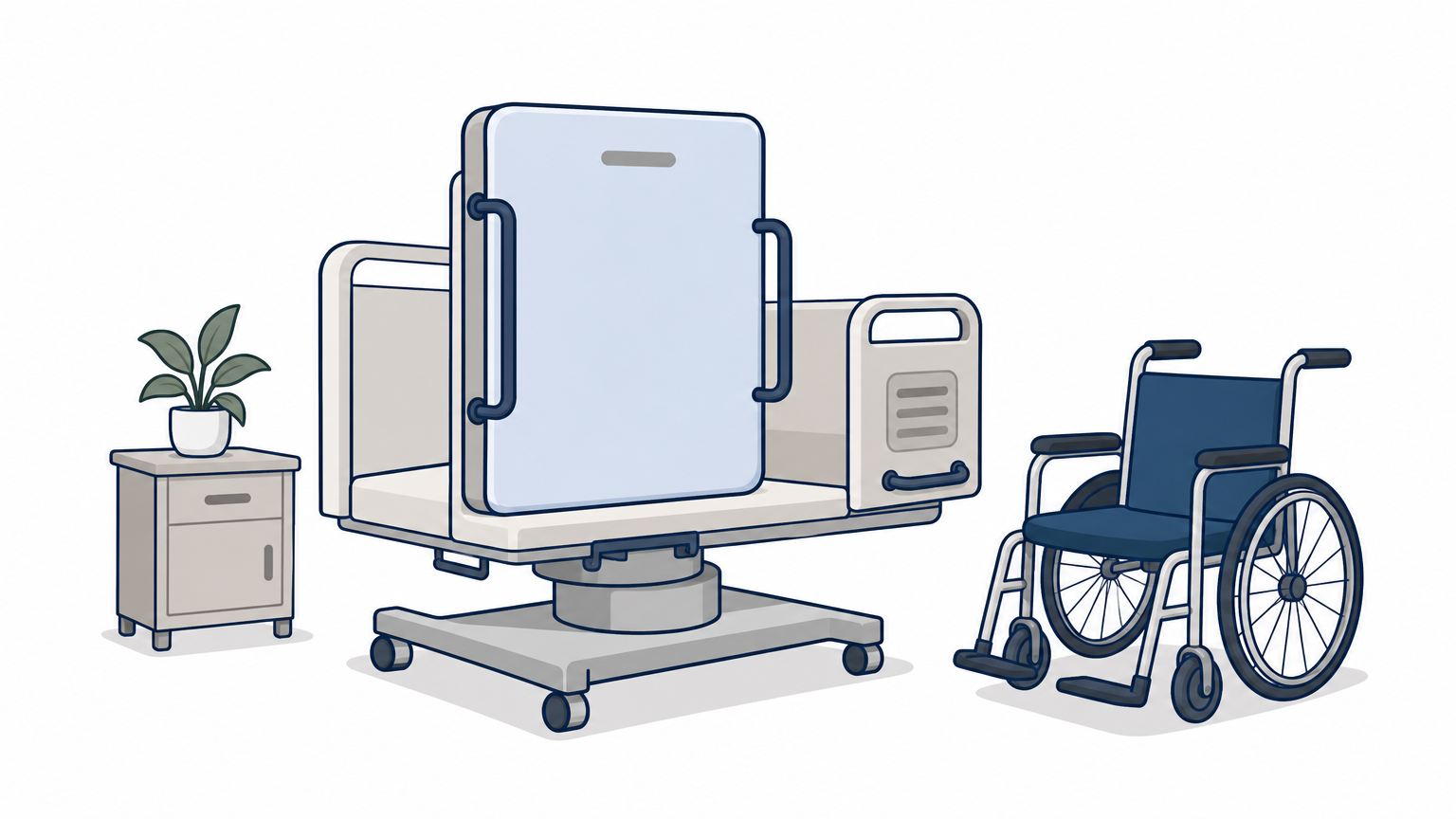
A rotating bed doesn't just support a senior's body, it replaces the moment where most home falls actually happen.
Key features
The rotation function is the headline feature, but the beds around it are engineered for the same goal: independence with control.
- Powered rotation of the mattress deck, typically 90 degrees, so the sleeper ends up seated at the edge of the bed facing forward
- Battery backup on most models, so a power outage doesn't strand someone mid-transfer
- Full electric height adjustment, letting the bed match wheelchair height or a caregiver's preferred working height
- Side rails or grab bars rated for real body weight, not just decorative hardware
- Quiet motors designed for bedroom use rather than clinical settings
- Furniture-style headboards and footboards on residential-focused models, so the bed doesn't look out of place next to a dresser or nightstand
Who it's best for
Rotating beds make the most sense for seniors who have lost the leg strength or balance to stand up unassisted but who still want to move around their home rather than stay bed-bound. Falls during transfers are one of the leading causes of hospital readmission for older adults, and the CDC's older adult fall prevention data consistently flags getting in and out of bed as a high-risk moment. Independent living is the real draw here: someone recovering from a hip replacement, choosing a bed for Parkinson's, or dealing with severe arthritis can often keep transferring themselves for months or years longer with a rotating bed than they could with a standard frame. Caregivers benefit too, since the bed does the physical work that used to require lifting or a second person in the room.
This category isn't necessary for every senior with mobility limits. If someone can still pivot and stand with a bit of help from a walker or a caregiver's arm, a hi-low adjustable bed (covered next) usually covers their needs at a lower cost. Rotating beds earn their price when standing up has become genuinely unsafe without powered assistance, and it's worth comparing the rotating models side by side before you commit.
Price range
Rotating sit-to-stand beds sit at the top of the home hospital bed market because of the added motor, sensors, and reinforced frame the rotation function requires.
| Feature level | Typical price range |
|---|---|
| Entry rotating models | $4,500 to $6,000 |
| Mid-range with battery backup and premium finish | $6,000 to $7,500 |
| Full-featured, furniture-grade rotating beds | $7,500 to $9,000+ |
Most buyers land in the middle of that range once they add side rails, a pressure-relief mattress, and delivery with professional installation. It's a significant investment, but compare it against the monthly cost of in-home aide hours spent purely on transfer assistance, and the math often favors the bed within a year or two.
2. Hi-low adjustable beds with furniture-grade design
Hi-Low adjustable beds solve a different problem than rotating beds, and what a hi-low bed actually does for home care comes down to height rather than rotation. Instead of powering a full standing transfer, they simply move the entire bed frame up and down, so the mattress height matches whatever the sleeper needs at that moment. Lower the bed to sit safely at the edge and stand up under your own power, or raise it to wheelchair height for an easier side transfer. Flex-A-Bed built its whole reputation on this category, and models like the Flex-A-Bed 185 Hi-Low SL remain among the most popular choices for seniors who need support without full clinical equipment. SlumberSource carries several Flex-A-Bed models alongside its own fall-safe hi-low bed line, both designed to look like real bedroom furniture rather than a rental hospital bed.
A hi-low bed gives a senior back the one thing arthritis and weak knees take away first: the ability to sit down and stand up without help.
Key features
The defining feature is height range, but the rest of the bed matters just as much for daily comfort and safety.
- Full electric height adjustment, usually from around 8 inches to 30 inches off the floor
- Head and foot articulation, so the sleeper can elevate their upper body for reading, breathing issues, or acid reflux
- Wood or upholstered headboards and footboards that match residential bedroom sets
- Quiet motor systems built for nightly use in a shared bedroom
- Weight capacities typically in the 400 to 500 pound range, well above a standard bed frame
- Compatibility with standard queen or full-size mattresses, so replacing the mattress later doesn't mean replacing the whole bed
Who it's best for
This category suits seniors who still have decent leg strength and balance but struggle with the mechanics of a fixed-height mattress. Think arthritis in the hips or knees, recovery from a joint replacement, or chronic back pain that makes flat sleeping uncomfortable. It also works well for couples where only one partner has mobility limits, since the furniture-grade design, the kind you see when the SonderCare Aura, Harmony Passport and Dawn House are compared, doesn't turn the whole bedroom into a medical space. Compared to a rotating sit-to-stand bed, hi-low models are the right call when someone can still manage the actual standing motion themselves, they just need the starting height to cooperate.
Price range
| Feature level | Typical price range |
|---|---|
| Basic hi-low frames | $2,000 to $3,000 |
| Mid-range with upholstered finish | $3,000 to $4,500 |
| Premium furniture-grade models | $4,500 to $6,000 |
Most families spend around $3,500 once delivery and installation are included, making this the more accessible entry point into powered home care beds.
3. Clinical-grade hospital beds for full-time care
Some seniors need more than height adjustment or an easier way to stand up, they need a bed built for round-the-clock care. Clinical-grade hospital beds bring true medical functionality into the bedroom: full-body positioning, pressure-relief support, and frames engineered for someone who spends most of their day in bed rather than just sleeping in it. iCare and Med-Mizer both manufacture beds in this tier, built to the same standards you'd find in a hospital or skilled nursing facility, just finished for a home setting. SlumberSource's line of med surg beds with Trendelenburg and auto-contour keeps that medical-grade engineering while swapping the institutional look for a residential frame.
A clinical-grade bed exists for one reason: to keep someone comfortable and safe when they can no longer manage most of their own positioning.
Key features
These beds are built around total control over body position, since a caregiver or the patient often needs to adjust posture many times a day.
- Full electric articulation at the head, foot, and sometimes the knee gatch, to prevent sliding and reduce pressure sores
- Trendelenburg and reverse Trendelenburg positioning on higher-end models, used for circulation or breathing support
- Reinforced steel frames rated for heavy daily use, not occasional adjustment
- Compatible pressure-relief mattresses, often low-air-loss or alternating pressure systems sold alongside the frame
- Locking casters for safe repositioning within a room
- Bed exit alarms and rail options for patients at risk of falling or wandering
Who it's best for
This category fits seniors managing advanced conditions such as late-stage dementia, ALS, severe stroke recovery, or long-term bedbound care after major surgery. It's also the right choice for families managing hospice care at home, where positioning changes throughout the day are constant and pressure sore prevention becomes a daily concern. If a senior is mostly mobile and just needs help sitting up or standing, a hi-low or rotating bed covers that need at a lower cost. Clinical-grade beds earn their place when the person spends the majority of their time in bed and needs a caregiver, not the bed itself, driving most position changes.
Price range
| Feature level | Typical price range |
|---|---|
| Standard clinical frames | $2,500 to $4,000 |
| Full-featured with Trendelenburg positioning | $4,000 to $6,000 |
| Premium models with pressure-relief mattress included | $6,000 to $8,000+ |
Expect the pressure-relief mattress itself to add a meaningful chunk to the total, since low-air-loss systems aren't cheap but significantly reduce the risk of skin breakdown for bedbound patients, as our breakdown of foam versus air surfaces for a hospital bed explains.
4. Low-height beds that help prevent falls
Not every mobility risk comes from standing up. For a lot of seniors, the real danger happens getting into bed or rolling out of it during the night. Low-height beds solve this by sitting much closer to the floor than a standard frame, sometimes as low as 3 to 5 inches, so a fall from the mattress edge becomes a short drop instead of a hard landing. Accora built its reputation on this exact niche with its floor-level bed systems, and SlumberSource's ultra-low and floor beds for fall prevention follow the same principle: reduce the distance between the mattress and the floor, and you reduce the severity of nearly every fall that happens near the bed.
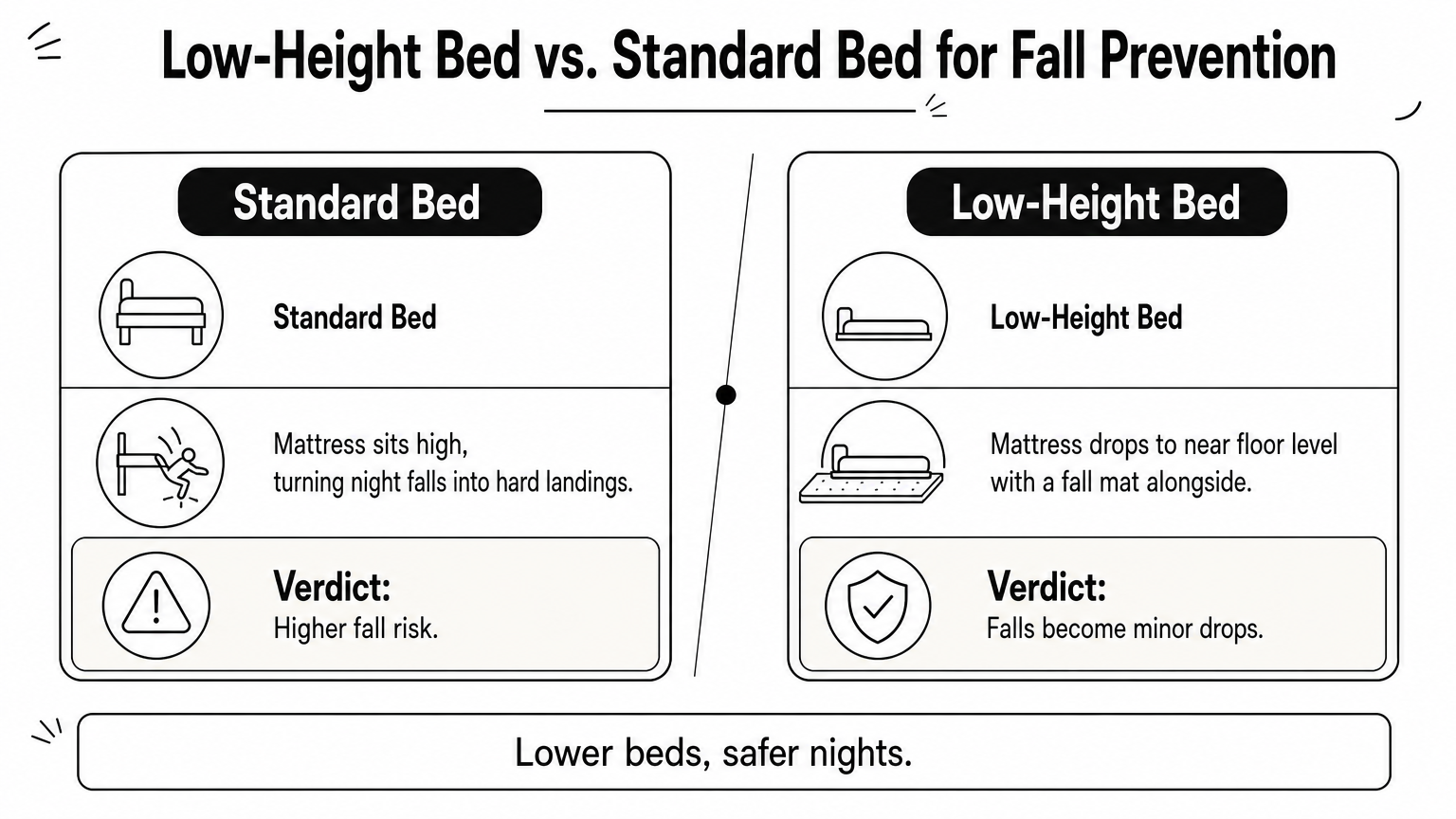
Lowering the bed doesn't stop falls from happening, it stops them from becoming emergencies.
Key features
Low-height beds trade some of the powered functionality of rotating or hi-low models for one specific safety advantage: proximity to the ground.
- Floor-level mattress height, often adjustable from around 3 inches up to a more standard 24 inches
- Fall mats designed to sit flush against the bed frame, cushioning any roll-off without a gap for limbs to slip into
- Bed rails or bolsters positioned to prevent rolling rather than assist with standing
- Motion or pressure sensors on some models, alerting caregivers when someone gets up at night
- Compact frame designs that fit in smaller bedrooms without the bulk of a full hospital bed
- Wood or upholstered finishes on residential models, keeping the room from feeling clinical
Who it's best for
This category makes the most sense for seniors dealing with dementia, night wandering, seizure risk, or a history of rolling out of bed unassisted. It also suits anyone whose falls tend to happen at night rather than during a deliberate transfer, since a low bed removes most of the danger without requiring a caregiver to be present every time. Families managing memory care at home with a wander-safe bed setup lean on this style heavily, because it addresses a risk that powered rotation or height adjustment doesn't touch. If the bigger issue is standing up safely during the day, a rotating or hi-low bed still matters more than floor height alone.
Price range
| Feature level | Typical price range |
|---|---|
| Basic low-height frames | $2,000 to $3,000 |
| Mid-range with fall mat and rails included | $3,000 to $4,000 |
| Full-featured with sensors and premium finish | $4,000 to $5,500 |
Most families pair a low bed with a fall mat purchased at the same time, since buying them separately later often costs more than bundling delivery and installation upfront.
5. Beds with trapeze bars and transfer aids
Some seniors don't need a bed that rotates or drops low to the floor, they just need something to pull on. A trapeze bar attaches to the head of the bed frame and lets someone with decent upper body strength reposition themselves, sit up, or shift their weight without waiting on a caregiver. Pair that with a set of transfer aids, like a slide board or a swiveling seat cushion, and you get one of the simplest, cheapest ways to preserve independence for someone whose legs have weakened but whose arms and shoulders still work fine. This combination often gets overlooked when families search for the best bed for seniors, but it solves a real gap between full rotation and no assistance at all.
A trapeze bar turns "I need help getting up" into "I've got it" for a lot of seniors who still have strong arms.
Key features
These add-ons work with almost any hospital bed frame, which keeps the setup flexible and affordable.
- Freestanding or bed-mounted trapeze bars, rated for 250 to 400 pounds depending on the model
- Adjustable height and reach, so the bar sits within comfortable grabbing distance from any sleeping position
- Slide boards and transfer boards for lateral moves between bed and wheelchair without a full stand
- Overhead frames that clamp directly onto hospital bed rails rather than requiring a separate base
- Padded grip handles designed to reduce strain on arthritic hands
- Compatibility with hi-low and clinical-grade frames, so the bar can move to a new bed later if care needs change
Who it's best for
This setup suits seniors using a hospital bed after surgery on the lower body, living with paralysis limited to the legs, or managing conditions like severe osteoarthritis in the hips and knees where the upper body remains strong. Occupational therapists often recommend adding a trapeze bar before jumping straight to a rotating bed, since it's a much smaller investment that can extend independent living by months. Caregivers should know it's not a substitute for rotation or lift assistance once someone loses significant arm strength too, at that point a powered rotating bed becomes the safer call.
Price range
| Feature level | Typical price range |
|---|---|
| Basic trapeze bar attachment | $150 to $300 |
| Bed-mounted overhead frame | $300 to $600 |
| Full transfer aid bundle (bar plus slide board) | $500 to $900 |
Because these attach to an existing frame, most families add one to a bed they already own or bundle it into a new adjustable bed purchase at checkout.
6. Zero-gravity beds for back and joint pain
Zero-gravity positioning takes its name from NASA research on how astronauts' bodies settle under reduced strain, and the same principle helps seniors dealing with chronic back or joint pain at night. Instead of lying flat, the bed raises the legs slightly above heart level while elevating the upper body, distributing weight evenly across the spine and taking pressure off the lower back. Flex-A-Bed and several of SlumberSource's own frames build a one-touch zero-gravity preset into their adjustable models, so a senior doesn't need to fiddle with separate head and foot controls every night. For anyone researching the best bed for seniors dealing with sciatica, spinal stenosis, or arthritic hips, this feature often matters more than any other single spec.
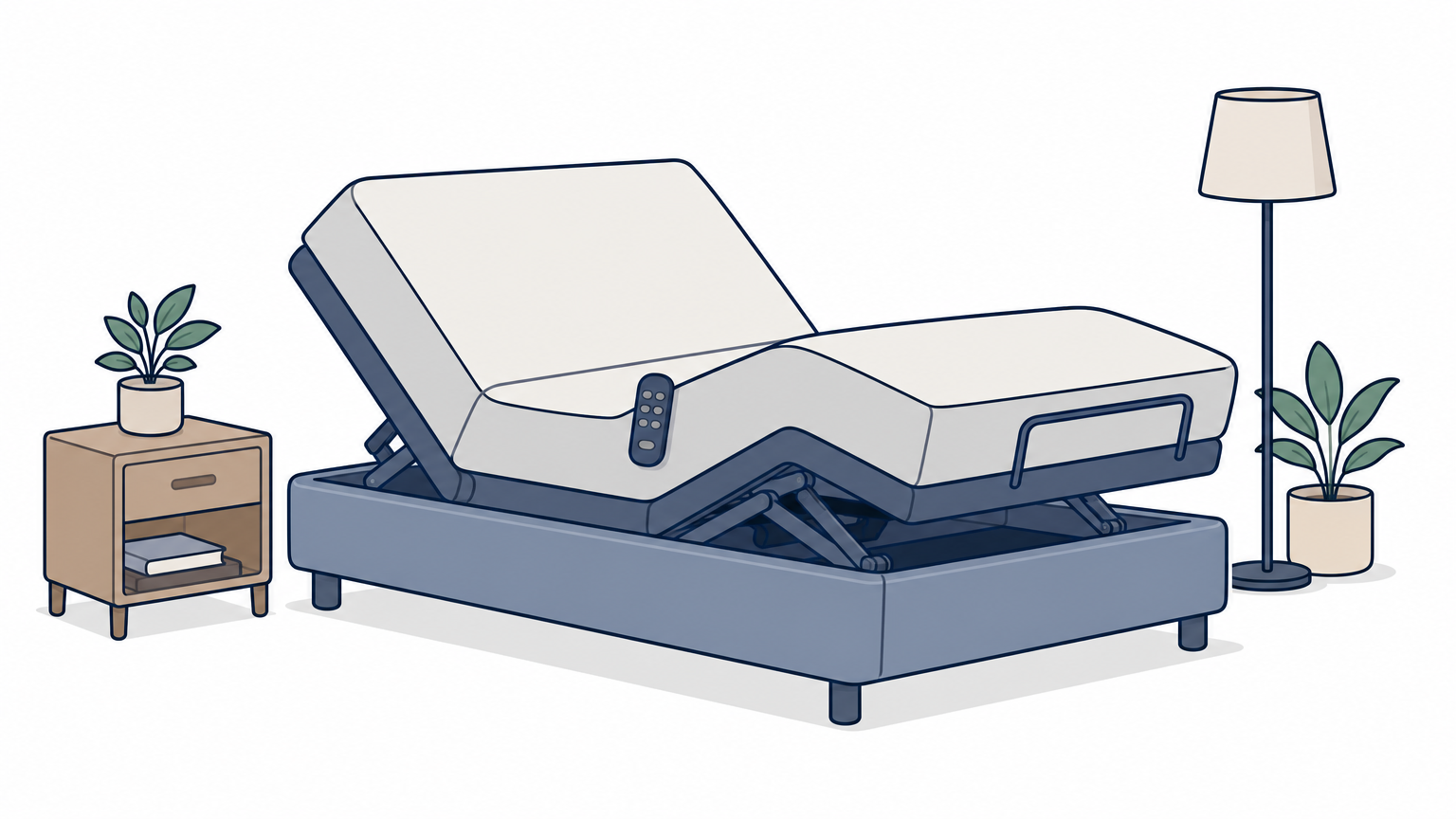
Zero-gravity positioning doesn't cure joint pain, but it takes enough pressure off the spine that a lot of seniors finally sleep through the night.
Key features
The zero-gravity preset is the headline draw, but the surrounding features determine how comfortable and easy the bed is to live with day to day.
- One-touch zero-gravity preset, automatically raising the legs and torso to a pre-calibrated angle
- Independent head and foot articulation, allowing manual fine-tuning beyond the preset
- Massage functions on many models, often built into the same remote as the positioning controls
- USB charging ports and under-bed lighting, small conveniences that matter for nighttime bathroom trips
- Quiet dual motors, since head and foot movement usually run separately rather than on one shared motor
- Compatibility with most memory foam or hybrid mattresses, so pressure relief isn't limited to one mattress brand
Who it's best for
Seniors managing chronic lower back pain, sciatica, or swelling in the legs and feet tend to notice the biggest difference with zero-gravity positioning. It also helps people recovering from spinal surgery, where lying completely flat puts unwanted strain on healing tissue. Unlike rotating or clinical-grade beds, this category assumes the sleeper can still get in and out of bed independently, the value here is comfort and pain relief rather than transfer assistance. If standing up is the bigger struggle, a hi-low or rotating bed still takes priority over zero-gravity features alone.
Price range
| Feature level | Typical price range |
|---|---|
| Basic zero-gravity adjustable frames | $2,200 to $3,200 |
| Mid-range with massage function | $3,200 to $4,500 |
| Premium furniture-grade models | $4,500 to $6,000 |
Most buyers land near the middle of this range once they add a compatible mattress, and many find the zero-gravity adjustable bed collection covers the comfort gains without the higher cost of clinical positioning features they don't actually need.
7. Bariatric beds built for higher-weight sleepers
Standard hospital beds and adjustable frames usually cap out around 450 to 500 pounds, which isn't enough for a meaningful share of seniors managing obesity alongside mobility loss. Bariatric beds solve this with reinforced steel frames, wider mattress decks, and motors rated to lift far more weight without straining. Med-Mizer and iCare both build dedicated bariatric lines, and SlumberSource's collection of beds rated from 500 to 1,000 pounds carries several of these frames specifically sized and rated for higher-weight sleepers rather than a standard bed pushed past its limits. This category matters for anyone searching for the best bed for seniors who don't fit the assumptions built into a typical medical bed spec sheet.
A bariatric bed isn't a bigger version of a standard hospital bed, it's a different piece of engineering built around real weight capacity.
Key features
Every feature in this category exists to support significantly more weight without sacrificing the powered functions seniors rely on for transfers and positioning.
- Reinforced steel frames rated from 600 up to 1,000 pounds depending on the model
- Wider mattress decks, often 42 to 48 inches compared to 36 inches on a standard bed
- Heavy-duty motors built to lift greater loads without slowing down or overheating
- Reinforced side rails and grab bars rated for higher weight than standard hardware
- Wider door-clearance frame designs, since bariatric beds sometimes need to disassemble for delivery into smaller homes
- Compatible bariatric mattresses, built with denser foam cores that resist bottoming out
Who it's best for
Families shopping this category usually have a senior managing obesity, lymphedema, or a condition that limits mobility while also carrying significant body weight. Regular adjustable frames put these sleepers at real risk of frame failure or motor burnout within a year or two, so the reinforced build isn't a luxury, it's the difference between a bed that lasts and one that doesn't. Occupational therapists frequently steer families toward bariatric-rated frames even when a standard bed looks like it might technically hold the weight, since safety margins matter more than a manufacturer's minimum spec, and our 2026 guide to bariatric beds for home lays out those margins model by model.
Price range
| Feature level | Typical price range |
|---|---|
| Standard bariatric frames | $4,000 to $5,500 |
| Mid-range with electric positioning | $5,500 to $7,000 |
| Full-featured, higher-capacity models | $7,000 to $9,000+ |
Expect the mattress to add several hundred dollars on top of the frame price, since bariatric-rated foam costs more to manufacture than standard adjustable bed mattresses.
8. Split king adjustable beds for couples
Many seniors sleep next to a partner who doesn't need the same mobility support, and a single hi-low frame forces one person's needs onto both sleepers. Split king adjustable beds solve that by using two separate twin XL frames pushed together under one mattress set, so each side moves independently. One partner can raise their upper body to read or manage acid reflux while the other stays flat, and a senior recovering from surgery can adjust height or elevation without disturbing anyone's sleep. SlumberSource's split king adjustable bed options pair this dual-control setup with the same furniture-grade finishes found across the rest of the lineup, so the bedroom still looks like a bedroom instead of two hospital beds pushed together.
A split king lets two people share a room without sharing a single set of mobility needs.
Key features
The defining trait is independent control, but the frame construction and mattress compatibility matter just as much for a couple sharing one bedroom.
- Two independent remotes, each controlling height, head, and foot articulation on its own side
- Zero-gravity and massage presets available separately per side on many models
- Twin XL split mattresses designed to sit flush together, minimizing the gap sleepers notice between sides
- Synchronized or matching finishes on the frame, so the bed doesn't look mismatched despite being two separate units
- Individual weight capacities per side, typically 400 to 450 pounds, rather than one shared rating
- Quiet motors on both frames, since one partner's adjustments shouldn't wake the other
Who it's best for
This setup fits couples where only one partner has mobility limitations from arthritis, recovery, or a chronic condition, while the other sleeps fine on a flat mattress. It also works well when both partners have different needs, one managing back pain with a zero-gravity preset, the other just wanting extra head elevation for sinus issues. Split king frames solve a relationship problem as much as a medical one: nobody wants to give up shared sleep just because their mobility needs diverge. Singles or seniors without a bed partner don't gain much from the split design and are usually better served by a standard hi-low or rotating frame at a lower price.
Price range
| Feature level | Typical price range |
|---|---|
| Basic split king frames | $3,500 to $5,000 |
| Mid-range with dual zero-gravity presets | $5,000 to $6,500 |
| Premium furniture-grade models | $6,500 to $8,500+ |
Because a split king requires two full frames and two mattress halves, expect the total cost to run higher than a single adjustable bed of comparable quality, even though each side is technically a twin XL, as the chart of split king and standard hospital bed dimensions shows.
9. Budget-friendly adjustable beds for seniors
Not every senior needs Trendelenburg positioning or a rotating deck. Plenty of families just want a budget-friendly adjustable bed that lifts the head and feet, holds up to daily use, and doesn't require a five-figure budget to get there. This category strips away the extras like massage motors and dual remotes, keeping the core function that actually matters for most seniors with mild to moderate mobility issues: powered head and foot articulation on a frame that fits a standard bedroom. SlumberSource's entry-level adjustable beds for seniors fall into this tier, built by the same brands as the premium lines but without the finishes that push the price up.
A budget adjustable bed proves you don't need every feature on the spec sheet to solve the one problem that actually matters at night.
Key features
These frames keep the essentials that make a real difference for comfort and safety, without the premium hardware that drives up cost elsewhere in this list.
- Electric head and foot articulation, controlled by a simple wired or wireless remote
- Standard mattress compatibility, usually twin, full, queen, or king sizes without a proprietary mattress requirement
- Basic weight capacity around 350 to 400 pounds, sufficient for most non-bariatric users
- Simple metal or low-profile frames, often without upholstered headboards
- Manual or single-motor systems, trading dual-motor speed for a lower price point
- Compatibility with existing bedroom furniture, since many ship as a base frame meant to slide under a current bed setup
Who it's best for
This tier suits seniors managing mild arthritis, acid reflux, or general stiffness who need elevation more than full medical functionality. It also works well for families testing whether an adjustable bed helps before committing to a pricier clinical or rotating model down the line, once they understand the difference between an adjustable bed and a hospital bed. Anyone managing a tighter budget after covering other care costs, home modifications, or medical bills finds real value here, since the core comfort benefit doesn't disappear just because the price does. If a senior struggles to stand or transfer independently, though, this category won't cover that gap the way a hi-low or rotating bed will.
Price range
| Feature level | Typical price range |
|---|---|
| Basic single-motor frames | $900 to $1,500 |
| Mid-range with wireless remote | $1,500 to $2,200 |
| Higher-end budget models with sturdier frames | $2,200 to $2,800 |
Most families spend under $2,000 total, including delivery, making this the most accessible starting point for anyone unsure how much adjustability their loved one actually needs, and cheaper than renting once you run the real math on renting versus buying a bed.
Choosing the right bed for safer, better sleep
Matching the bed to the actual problem matters more than chasing the fanciest model on this list. A senior who just needs help sitting up doesn't need a rotating deck, and one who can no longer stand safely won't get enough from a basic budget-friendly adjustable bed. Start with the specific mobility challenge in front of you, transfers, nighttime falls, chronic pain, or full-time positioning, and let that answer drive the purchase.
Whatever category fits, don't guess on specs or sizing alone. The best bed for seniors with mobility issues is the one installed correctly, with rails, mattress, and height dialed in for the person actually using it, not just ordered online and left in a box. SlumberSource ships nationwide in 3 to 8 days with professional installation included, so you get expert setup instead of a DIY guess. Browse the full range of hospital beds for home use, starting at $1,568 and talk to their team about which model fits your situation before you buy.


